Friday, August 3, 2018

Thoughts of the Day

Photo by Sara Fogan


Every now and then I like (and need) to take a few moments and remind myself about what is really important to me, in my life. If you follow me on my Calminsense Hypnotherapy Facebook page you may have seen some of these quotes before on this page, or will in the future. Many of these Quotes of the Day are beautiful examples and illustrations of the work I do as a hypnotherapist, so I will probably draw on them in future essays.


  • “You can fail at what you don’t want, so you might as well take a chance at doing what you love.” – Jim Carrey, Actor/Comedian

  • “If you could kick the person in the pants responsible for most of your trouble, you wouldn't sit for a month.” – Theodore Roosevelt

  • “You alone are the judge of your worth and your goal is to discover infinite worth in yourself, no matter what anyone else thinks.” – Deepak Chopra

  • “Being the ‘bigger man or woman’ requires a smaller ego and larger self-esteem.” – Bille Baty

  • “I'd rather live with a good question than a bad answer.” – Aryeh Frimer

  • “For a seed to achieve its greatest expression, it must come completely undone. The shell cracks, its insides come out and everything changes. To someone who doesn’t understand growth, it would look like complete destruction.” – Cynthia Occelli

  • "This suspense is terrible. I hope it lasts.” – Oscar Wilde


  • “People will stare. Make it worth their while.” – Harry Winston

  • “We cannot control what happens to us, but we can control what we do next.” – Lolly Daskal


Sara R. Fogan, C.Ht. is a certified hypnotherapist based in Southern California. She graduated with honors from the Hypnosis Motivation Institute in 2005. For more information about Calminsense Hypnotherapy® and to set up an appointment, please visit http://www.calminsensehypnotherapy.com/.
© 2018

Thursday, August 2, 2018

The Horse as Equine Partner

(This blog was originally posted on May 18, 2011)

Photo courtesy of Sara Fogan


I believe that people who train and work with horses should aim to achieve a partnership with their horse. I love the way Monty Roberts and Kelly Marks talk about their “equine partners” when they teach horsemanship and training techniques. My trainers teach every student at the barn to consider and interact with their mount as an equine partner. But, what does this term really mean? What does it mean to be a human partner to your horse?
Enid Bagnold’s classic novel, National Velvet, depicts a teenage Velvet Brown’s bond with a piebald gelding, which she rides to victory in the Grand National horse race. In Walter Farley’s The Black Stallion, Alec Ramsay earns the trust of an Arabian stallion when they are shipwrecked on a deserted island. “The Black” demonstrates his devotion to Alec when he kills a cobra poised to bite the boy; after they are rescued, Alec enlists the help of a former jockey to train them for an important race. Finally, in one of the most exciting scenes in my favorite movie, The Man From Snowy River, Jim Craig’s trusted mount gallops at breakneck speed, headlong down a cliff and over rugged terrain in their quest to round up a herd of wild horses.
Now, consider the horses that you have known in your life: The horse that carried you safely home when you were sure that you were “lost” on the trail. The horse who, even after “dumping” you at that oxer, stood patiently beside you and waited for you to catch your breath (and gathered your pride) before climbing on his back. The horse that braced his body perpendicular to a steep incline, allowing you to pull yourself up the hill by using the reins and his weight as leverage. Finally: The horse that carried you to a first-place win after crossing 100 miles of grueling terrain in an endurance race, or bested the other equine athletes at a three-day, combined-training event. How—or, why—do they do these things for us?
While considering this question, I am reminded of the famous challenge in President Kennedy’s inaugural speech: “Ask not what your country can do for you, but ask what you can do for your country.” I believe that this theme forms the basis of the partnership that is forged between a horse and his rider. Rather than focus on the prize or reward that is being offered at the end of the ride, consider what it takes to achieve that goal.
Spend time watching your horse in pasture and take the time to learn how to communicate and interpret the horse’s body language. Groom him and establish a mutual bond of trust and respect before you even think about climbing onto his back. Rather than jabbing a spur into his side and demanding your horse to go forward, first “ask” him to walk/trot/canter out with gentle aid, such as a cluck or squeeze. Reward the horse with praise and gentle pats when he does what you have asked. When you must correct the horse’s behavior, be firm—but fair: refusing to go forward because he is belligerent is not the same thing as not understanding what you have asked him to do. If your horse spooks at something on a trail or in the arena, help him to build his confidence by remaining patient and calm through the incident. Be an example of bravery as you desensitize him to what has previously startled him. Demonstrate and reinforce your role as herd leader by providing him with food, water, shelter, and time to just be a horse.
As Kelly Marks writes, if you can “be the owner your horse would choose for himself,” he can be a reliable equine partner for you.


Sara R. Fogan, C.Ht. is a certified hypnotherapist based in Southern California. She graduated with honors from the Hypnosis Motivation Institute in 2005. For more information about Calminsense Hypnotherapy® and to set up an appointment, please visit http://www.calminsensehypnotherapy.com/.
© 2018
Wednesday, August 1, 2018

Inferential Learning


(This blog was originally posted on June 13, 2016)


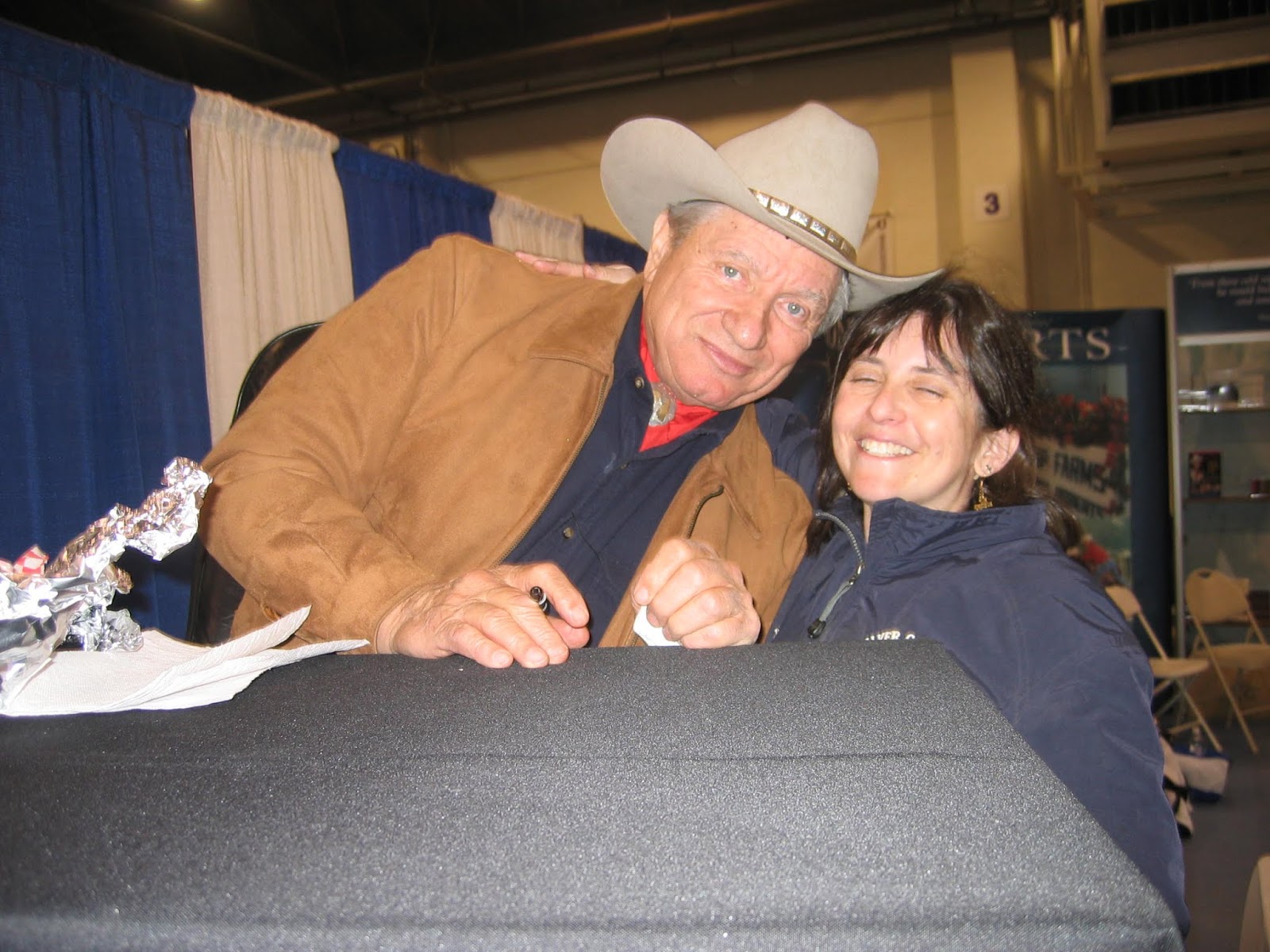
Me with Monty Roberts at the Pomona Equine Affaire in 2008
Photo courtesy of Sara Fogan


The first time I heard the term “inferential learning” was at a Monty Roberts horse-training seminar at the 2008 Equine Affaire in Pomona, California. To help a horse overcome its fear of obstacles, Mr. Roberts asked some assistants to roll and lay out a blue tarp on the ground for the animal to investigate. Over the course of about 10 minutes or so, the horse sniffed, pawed at and eventually put a hoof on the tarp. With some encouragement and tons of praise, he eventually built up enough confidence to stand on the material. Mr. Roberts explained that this process facilitated the horse’s inferential learning: by allowing it to investigate at its own speed and even make a few mistakes along the way—the horse did balk at the tarp when it was first laid out—he was able to figure out how to negotiate the new stimulus and get the situation to work for him.

I went through a similar process when I started to write this blog two years ago.

For some reason, the cursor pad on my laptop stopped working a few weeks ago. The technicians at Staples deduced there was a problem with the computer but I could easily navigate the screen with an external mouse. That was no problem until tonight, when the cursor froze again. This time I was in my office waiting for a client to arrive; there was no time to go back to Staples to get assistance. If I couldn’t use the computer it wouldn’t be the worst thing—I would have to improvise creating the reinforcement track on a different machine at home, was all. However, I had a few minutes to spare so I decided to figure out a way to resolve my problem, a la inferential learning.

I knew that the remote external mouse I use worked off of a USB attachment, so I started moving the attachment back and forth to different ports. I soon discovered that one of the ports was not working at all, but I had no problem using the mouse when it was plugged into one of the other ports. Phew! At least I could get my work done this evening and deal with the defective USB port when I had more time (and no one waiting for me).

Once again, I had to credit my hypnotherapy training for helping me remain calm and using the rational, logical part of my mind to address the unexpected challenge. Ten years ago, I probably (definitely) would have become panicked and frustrated right away. I am sure that it would have taken a lot longer for me to even consider trying possible solutions for this problem. In fact, I felt like I imagine my horse does when he figures out a new movement in his dressage training. When he gets it right, his tail floats merrily from side to side and he even gets a little spring in his step when he trots off again. Whenever Galahad completes a turn on the haunches, a lateral movement he is currently learning, my trainer or I give him a lot of verbal praise and a few pats on his neck or shoulder to acknowledge his success.

Maybe I should give myself a pat on the back for my successful problem-solving with my computer.


Sara R. Fogan, C.Ht. is a certified hypnotherapist based in Southern California. She graduated with honors from the Hypnosis Motivation Institute in 2005. For more information about Calminsense Hypnotherapy® and to set up an appointment, please visit http://www.calminsensehypnotherapy.com/.
© 2018