Wednesday, August 1, 2018

Inferential Learning


(This blog was originally posted on June 13, 2016)
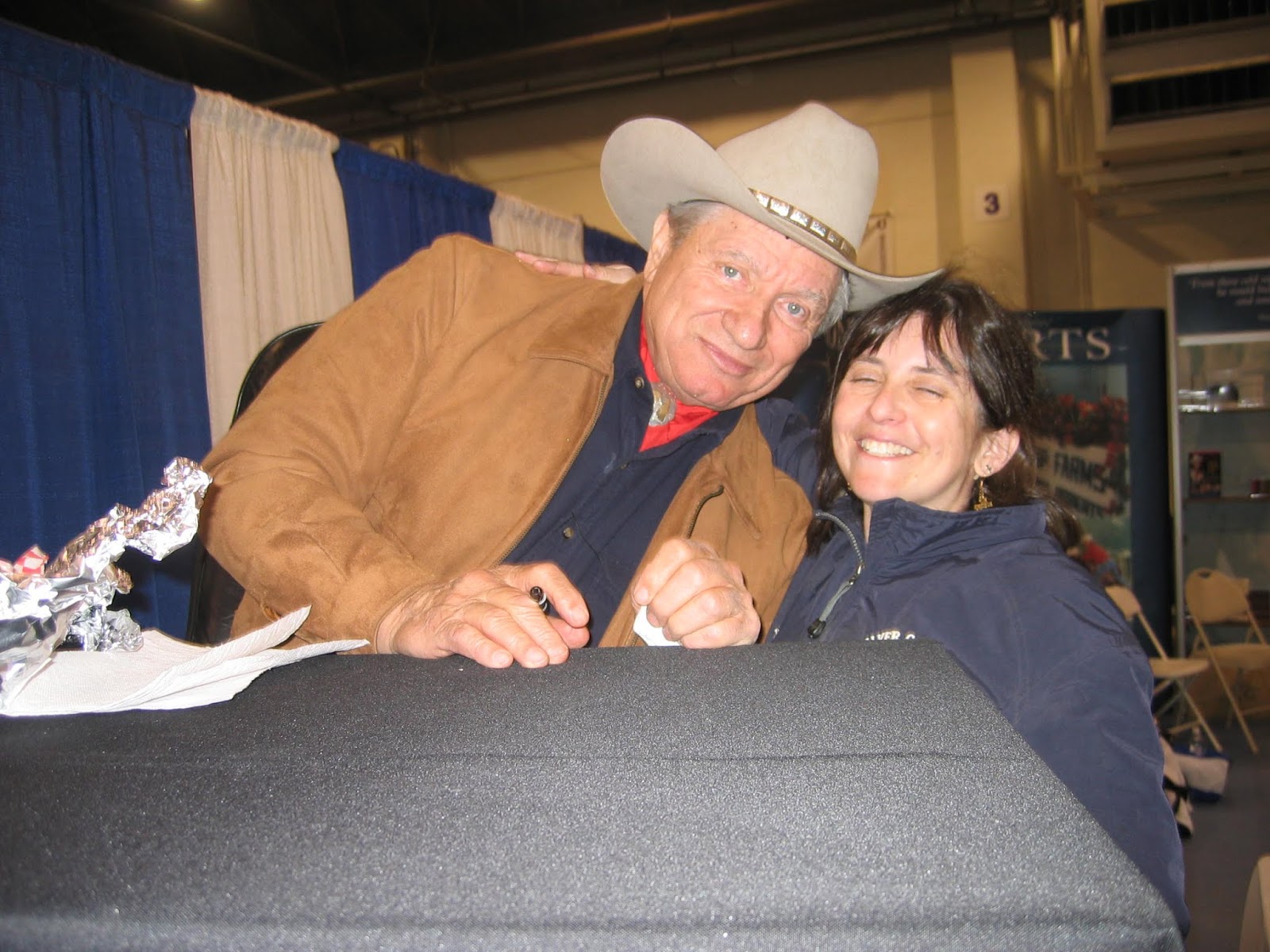

Me with Monty Roberts at the Pomona Equine Affaire in 2008
Photo courtesy of Sara Fogan


The first time I heard the term “inferential learning” was at a Monty Roberts horse-training seminar at the 2008 Equine Affaire in Pomona, California. To help a horse overcome its fear of obstacles, Mr. Roberts asked some assistants to roll and lay out a blue tarp on the ground for the animal to investigate. Over the course of about 10 minutes or so, the horse sniffed, pawed at and eventually put a hoof on the tarp. With some encouragement and tons of praise, he eventually built up enough confidence to stand on the material. Mr. Roberts explained that this process facilitated the horse’s inferential learning: by allowing it to investigate at its own speed and even make a few mistakes along the way—the horse did balk at the tarp when it was first laid out—he was able to figure out how to negotiate the new stimulus and get the situation to work for him.

I went through a similar process when I started to write this blog two years ago.

For some reason, the cursor pad on my laptop stopped working a few weeks ago. The technicians at Staples deduced there was a problem with the computer but I could easily navigate the screen with an external mouse. That was no problem until tonight, when the cursor froze again. This time I was in my office waiting for a client to arrive; there was no time to go back to Staples to get assistance. If I couldn’t use the computer it wouldn’t be the worst thing—I would have to improvise creating the reinforcement track on a different machine at home, was all. However, I had a few minutes to spare so I decided to figure out a way to resolve my problem, a la inferential learning.

I knew that the remote external mouse I use worked off of a USB attachment, so I started moving the attachment back and forth to different ports. I soon discovered that one of the ports was not working at all, but I had no problem using the mouse when it was plugged into one of the other ports. Phew! At least I could get my work done this evening and deal with the defective USB port when I had more time (and no one waiting for me).

Once again, I had to credit my hypnotherapy training for helping me remain calm and using the rational, logical part of my mind to address the unexpected challenge. Ten years ago, I probably (definitely) would have become panicked and frustrated right away. I am sure that it would have taken a lot longer for me to even consider trying possible solutions for this problem. In fact, I felt like I imagine my horse does when he figures out a new movement in his dressage training. When he gets it right, his tail floats merrily from side to side and he even gets a little spring in his step when he trots off again. Whenever Galahad completes a turn on the haunches, a lateral movement he is currently learning, my trainer or I give him a lot of verbal praise and a few pats on his neck or shoulder to acknowledge his success.

Maybe I should give myself a pat on the back for my successful problem-solving with my computer.


Sara R. Fogan, C.Ht. is a certified hypnotherapist based in Southern California. She graduated with honors from the Hypnosis Motivation Institute in 2005. For more information about Calminsense Hypnotherapy® and to set up an appointment, please visit http://www.calminsensehypnotherapy.com/.
© 2018

Tuesday, July 31, 2018

Recreating the Family of Origin


(This blog was originally posted on May 19, 2016)


Photo by Rick Hustead


When I was a freshman at Occidental College, I noticed something very interesting: all of the students looked the same. Well, not exactly the same, as in identical; but our similarity in physical features and even social backgrounds struck me as uncanny. One of my favorite instructors reminded me of my mother, from her general physique and gentle demeanor to the curly, salt-and-pepper dark hair they wore in a similar style. Maybe that resemblance contributed to her being one of my favorite professors. I remember that my fourth-grade teacher reminded me of one of my grandmothers; Mrs. Payne also happened to be one of my favorite grammar-school teachers. I don’t think that was a coincidence. One of the first good friends I made at Goldsmiths College in London, during my junior year abroad reminded me of my sister; they both even shared the same major in English literature.

On Tuesday, May 17, 2016, KFI AM 640 radio host Gary Hoffman and his featured guest, Wendy Walsh, Ph.D., discussed people’s subconscious mind's tendency to recreate the “home” or family environment/social schema where they work. Dr. Walsh’s description of this behavior sounded a lot like Hypnosis Motivation Institute founder John Kappas, Ph.D.’s Theory of Mind. No matter where we are or who we are with, we subconsciously want to return to those early experiences where we felt comfortable—even if we were experiencing pain in that situation. Both models made total sense.
Many people spend a majority of their waking day at work or at school/college. Whether it is a youngster’s first day in kindergarten or the first time newly minted CEO walks into the boardroom to facilitate a meeting, anxiety (pain) is usually the dominant emotion experienced. To alleviate this discomfort, we subconsciously look for any similarity between what he or she knows/knows how to do and other people with whom we have shared this previous environment or space. I remember the anxiety I experienced when the original owner of Black Belt magazine sold the company in 2001. All of the staff was anxious about our job security, even the senior editors and art directors. We all knew that the new line manager could easily decide this was a chance to “refresh” the current business model and get new writers and editors. Would our possible replacements actually be more skilled at our job or just a better social “fit” for the new boss? As it turned out, most of us kept our job and even got promotions when Black Belt magazine’s current owners bought and expanded the company a few years later. However, it was easy to see that new writers and editors that were hired were much more “like” and compatible with the new executive staff.
When I interviewed for college and, later, future jobs, I subconsciously looked for an environment where I already felt comfortable and shared interests/goals as the people with whom I would be sharing that environment. I have no doubt that Oxy’s college-acceptance board and my prospective employers had similar criteria when they considered how well I would fit in with them. The same could also be said of how I was originally recruited to join NRG—the business-network group to which I belong—and even, to some extent, how my clients “choose” to work with me as their hypnotherapist. What is similar? What is familiar? That is where we ultimately go—and stay.


Sara R. Fogan, C.Ht. is a certified hypnotherapist based in Southern California. She graduated with honors from the Hypnosis Motivation Institute in 2005. For more information about Calminsense Hypnotherapy® and to set up an appointment, please visit http://www.calminsensehypnotherapy.com/.
© 2018